Headless memory · governed execution · agent teams
The control plane for agentic work.
Give Claude Code, Codex, Cursor, Slack agents, internal agents, and custom ABots the same persistent memory, permission-aware context, run history, approval gates, and security evidence across your stack.
AMS is the headless memory and data substrate. AOS is the governed execution layer. The dashboard is the control room, not the destination.
Agents should not have to go to Automaton. Automaton should come with them into every tool where work already happens.
AMS
Headless memory infrastructure.
Expose memories, runs, automata, continuations, context, and skill loops through MCP, REST, and CLI surfaces.
→ Data substrate
AOS
Governed execution control plane.
Policy, trust tiers, scoped credentials, approvals, audit trails, and replayable execution history around agents that can act.
→ Runtime governance
Composable by design
One substrate for many agents.
Route work across model providers, IDE agents, chat agents, MCP tools, internal systems, and custom runtimes without losing context or control.
→ Agent team layer
§01 · The problem
Agent work fails when memory, permissions, and proof are missing.
The first failure is continuity. The second is uncontrolled data access. The third is evidence: once agents can act, teams need to know what they knew, what they touched, who approved it, and whether it worked.
01
Agents forget and restart from zero
Context disappears between tools and sessions. Users repeat themselves and the next run starts cold.
02
Repeated work never becomes reusable
Useful patterns stay trapped in chats, PRs, and logs. The team cannot replay, evaluate, or improve the work unit.
03
Ungoverned access creates risk
Agent actions need scoped credentials, inherited source permissions, approvals, audit trails, and containment before they belong near real systems.
§02 · Who it is for
Built for teams running agents across real tools.
Automaton is for teams that already use Claude Code, Codex, Cursor, Slack agents, custom agents, or internal tools, and need a shared substrate for memory, permissions, execution history, and improvement.
Engineering teams
Coding agents with project memory.
What breaks todayAgent context and decisions disappear across editors, terminals, repos, and sessions.
Automaton fixesAMS gives every compatible agent durable project memory, run history, and reusable work patterns.
OutcomeTeams stop re-teaching each agent the same architecture, incidents, and conventions.
AI platform teams
One substrate, many agents.
What breaks todayWork scatters across scripts, chats, MCP servers, dashboards, and vendor-specific agent stacks.
Automaton fixesAOS adds run replay, routing, approvals, telemetry, and composable MCP/REST/CLI access.
OutcomeTeams coordinate specialized agents without building a brittle super-agent.
Security-sensitive orgs
Evidence before autonomy.
What breaks todayAgent actions are hard to approve, audit, scope, or prove after the fact.
Automaton fixesTrust tiers, connector ACLs, credential grants, audit trails, and security verdicts make autonomy governable.
OutcomeSecurity teams get inspectable evidence instead of promises.
§03 · Governed run replay
One agent task becomes a replayable system of record.
The sales moment is not an abstract memory demo. It is a real run where Automaton shows the scoped context, permissions, approvals, security evidence, tool calls, outcome, and next improvement.
01 · Task enters through any agent
Claude Code, Codex, Cursor, Slack, ABot, or internal agent.
The agent calls Automaton through MCP, REST, CLI, or a channel gateway. The dashboard is available for inspection, but work starts where the team already works.
02 · Memory is scoped before retrieval
Context follows permissions.
AMS retrieves memories, runs, decisions, and source provenance only inside the actor's project, agent, tenant, and connector access envelope.
03 · Risk is checked before action
Policy before tool use.
Credential grants, trust tier, connector scope, DefenseClaw verdicts, and approval rules decide whether the action runs, waits, or stops.
04 · Trace spans connect the whole run
OpenTelemetry is the spine.
Agent run, MCP call, memory search, embedding, LLM call, automaton execution, approval, and audit event share one trace context.
05 · The work is replayable
Execution history becomes evidence.
Teams can inspect what the agent knew, what it touched, which tool ran, who approved risk, what changed, and where the result landed.
06 · The system improves
agent_run feeds skill_loop.
Successful runs can promote memories, update automata confidence, draft reusable skills, and leave continuations for the next specialized agent.
§04 · Memory proof snapshot
Measured against raw long-context. Same model. Same tasks.
Ten held-out MemoryArena tasks compare AMS retrieval against a raw long-context baseline. The benchmark keeps the model, judge, and task set fixed so the memory layer is the variable.
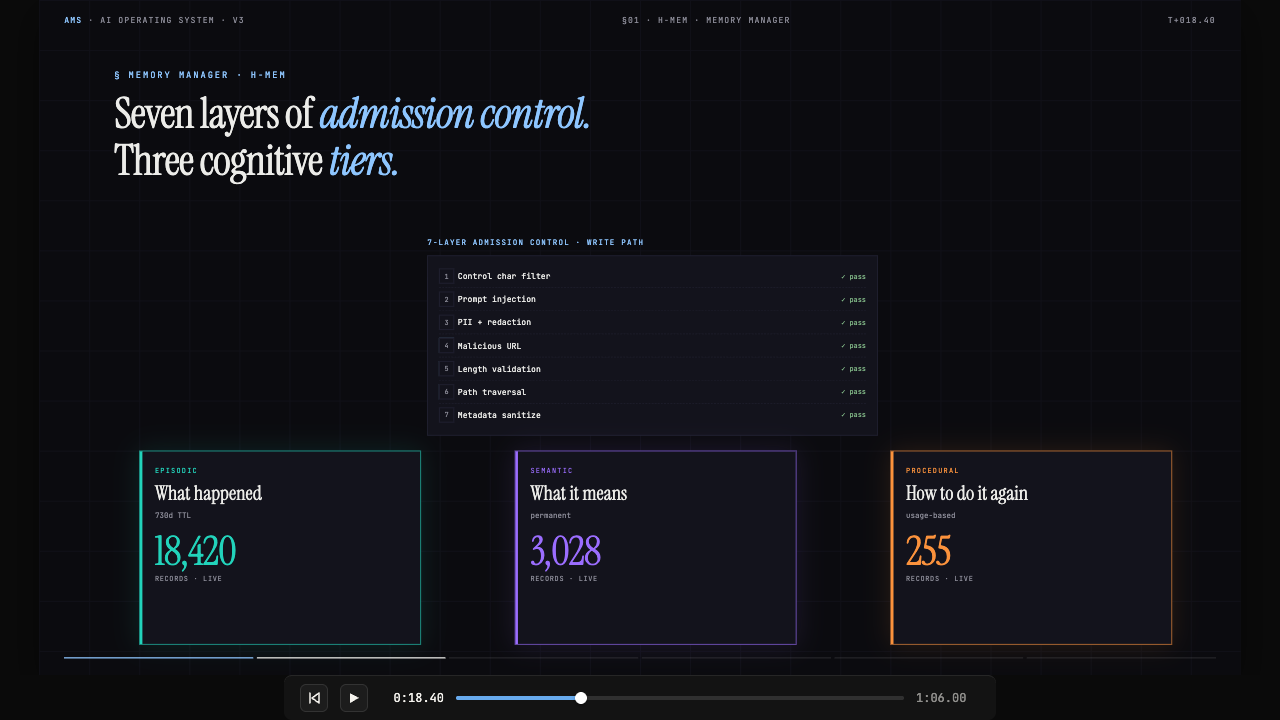
§01 · H-MEM · MEMORY MANAGER
Memory is the variable. H-MEM separates events, knowledge, and reusable procedures before retrieval brings context back into the run.video snapshot · Apr 20 2026
AMS produced a 67% higher task-success rate with 20% lower run cost on the same 10 tasks.
Hybrid vector + keyword search with reciprocal rank fusion brought the right stored context into the run. The model changed less; the context changed more.
Judge · claude-sonnet-4-6
AMS · hybrid + RRF over the memories table
Baseline · 0D raw context buffer, trajectory retrieval off
Sources · arena_math_ams_tuned_traj_20260325_062033.md · arena_math_long_context_tuned_plain_20260325_050421.md
MemoryArena · held-out math tasks 10–19 · Mar 25 2026
Condition
SR
PS
Cost
AMS H-MEM
0.50
0.7764
$33.28
Pure long-context
0.30
0.5532
$41.46
Δ AMS advantage
+20 pp
+0.22
−19.7%
What these numbers mean
The 67% / 20% comparison isolates the memory system by holding the model, judge, and task set fixed. The table above keeps the raw values visible: success rate 0.50 vs. 0.30, path score 0.7764 vs. 0.5532, and cost $33.28 vs. $41.46. Broader-domain claims are intentionally left off this page until they replicate.
AMS is the open-core data layer: memory storage, retrieval, graph links, run history, context state, automata outcomes, Obsidian sync, and procedural skill accumulation for agents that should improve across tools and sessions.
§05 · AMS · Headless memory layer
Memory that stores events, connects knowledge, and turns work into reusable operations.
AMS keeps three kinds of memory: what happened, what it means, and how to do it again. Under the hood that means H-MEM, hybrid retrieval, graph links, action history, agent runs, procedural automata, source provenance, and write-path admission control.
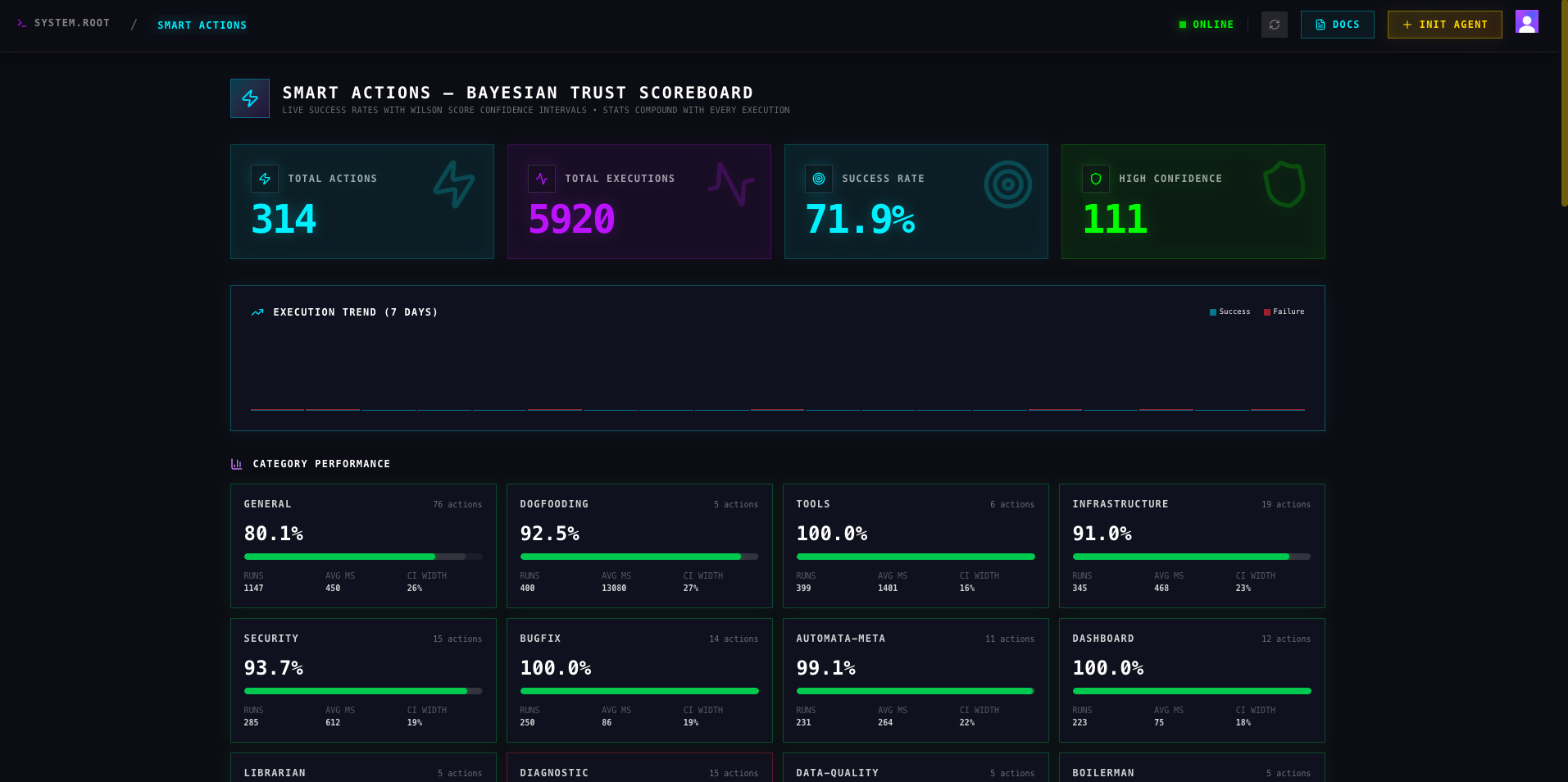
Reusable skill gets measured. Every action carries a Wilson-score interval that tightens as repeated work runs.dashboard snapshot · Apr 18 2026
01 · Run ledger + procedural memory
Repeated work becomes reusable work units.
agent_run records what happened; skill_loop turns useful patterns into reviewed skills and executable automata. They run in a sandbox, learn from outcomes, and transfer into related contexts.
Replayable run history and artifacts
Reviewed skill-loop promotion path
Docker + restricted-Python execution sandbox
Wilson-score confidence intervals per automaton
02 · Provenance-aware knowledge graph
Memories stay connected and scoped.
Link prerequisites, references, decisions, source systems, owners, and dependencies so one concept can bring the surrounding context without crossing permission boundaries.
03 · Hybrid search
Vector + keyword + policy.
Dense embeddings plus BM25 with reciprocal rank fusion. Retrieve the right memory after tenant, project, agent, and connector access rules are applied.
04 · Connector-aware ingestion
Curated ingestion with source truth.
Incoming content gets classified, tiered, deduplicated, linked, and stamped with source provenance before it becomes part of agent memory.
05 · Write-path admission control
Every memory write is inspected.
Control characters, prompt injection, PII, malicious URLs, length, path traversal, metadata, and optional DefenseClaw findings are checked before anything is admitted.
06 · MCP-native, but disciplined
Composable headless surface.
Stable umbrella tools expose memory, runs, automata, approvals, schedules, security, and routing without forcing external agents to learn every internal subsystem.
§06 · AMS · Architecture
Hierarchical memory (H-MEM), explained plainly.
AMS separates short-term events, durable knowledge, and reusable procedures. That lets agents retrieve the right context without treating every memory, run, decision, or skill as the same kind of record.
AOS is the control layer: schedules, trust tiers, scoped credentials, approval gates, audit trails, OpenTelemetry traces, DefenseClaw evidence, containment, and fleet visibility around agents that can act.
§07 · AOS · Execution control
Run agents with traces, approvals, and policy control.
AOS turns agent execution into governed infrastructure: scheduled work, trust-tier promotion, scoped credential grants, approval requests, security verdicts, run replay, pause and demotion controls, and a visible fleet register.
§03 · AOS · RUNTIME CONTROL
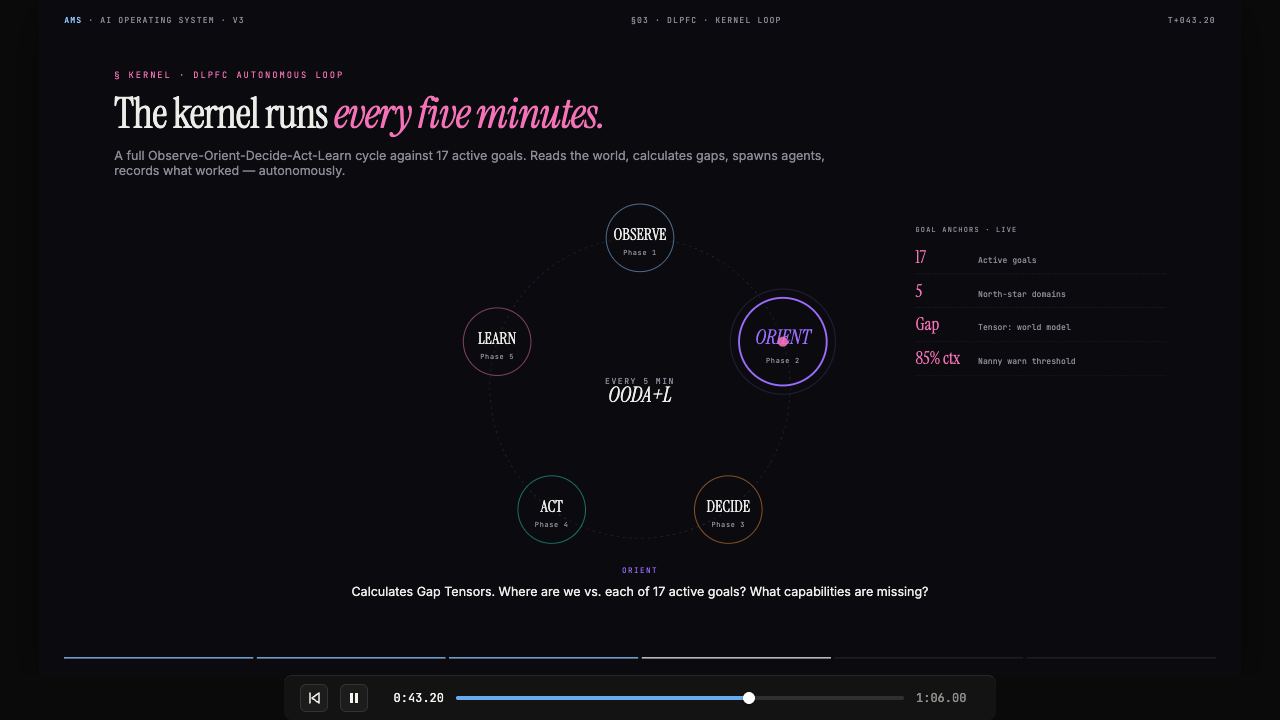
Observable runtime. The control layer shows schedules, active work, execution state, and the loop that writes outcomes back into AMS.video snapshot · Apr 20 2026
Control plane
Traces, queues, and fleet visibility.
Teams can see what is running, which agents are active, what tools are connected, which approvals are waiting, and what work is in the execution queue.
17
Active goals
6
Active schedules
99
MCP nodes in mesh
255
Automata in system
Contained autonomy
Policy before action.
Trust tiers, scoped credentials, audit logging, and containment triggers create a runtime where agent autonomy can be granted, reduced, paused, and reviewed.
T0
Recommend only
T1
Human approve
T2
Bounded autonomy
T3
Full autonomy
§08 · AOS · Governance
Trust tiers, approvals, and evidence turn autonomy into policy.
AOS keeps agent permissions explicit. Agents can recommend, request approval, operate inside bounds, or run with higher autonomy when policy, performance, credentials, and source-system permissions allow it.
§04 · TRUST TIERS · WARDEN
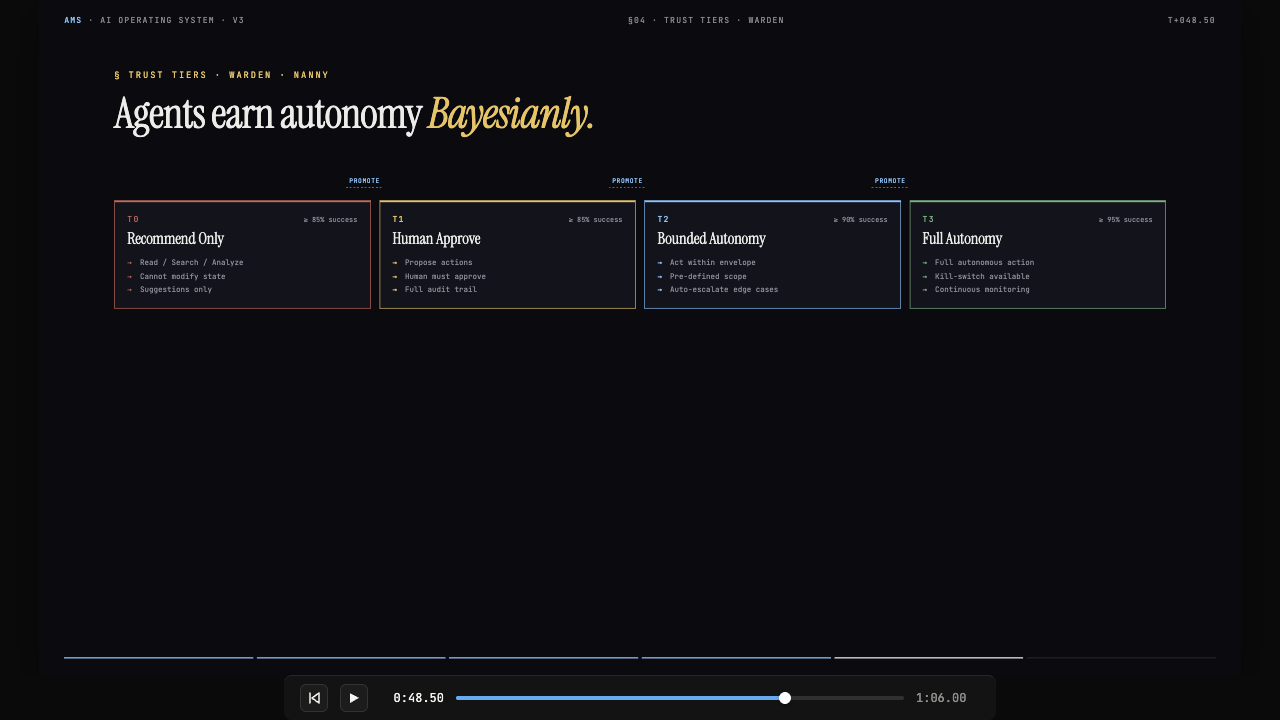
Promotion is earned. Policy enforcement and containment turn autonomy into thresholds, demotions, pauses, and audit trails.video snapshot · Apr 20 2026
Four trust tiers.
Autonomy is not a title; it is an operating envelope. Each tier defines what an agent can do without asking a human first.
T0
Recommend Only
reviewed action
T1
Human Approve
approval gate
T2
Bounded Autonomy
scoped action
T3
Full Autonomy
highest trust
Policy enforcement and containment.
When performance drops or context pressure spikes, the runtime can demote, quarantine, pause, or continue the agent under policy.
The point is not maximum autonomy. The point is observable, reversible autonomy.
§09 · Pricing
Memory is the foundation. Governed execution is the control layer.
Open-source memory core. Hosted memory, run replay, runtime governance, connector permissions, and enterprise controls are paid. The commercial path is simple: Start Free → AMS Professional → Add AOS → Contact Sales when compliance, RBAC, self-host, and SLA matter.
AMS · Free
Free
$0
/mo
Entry point and open foundation. Build the first two custom Automaton-Abots with memory from day one.
Most common pathStart with AMS Free, scale into AMS Professional when memory load grows, then add AOS when agent work needs permissions, approvals, replay, and control.
§10 · Explore next
Go deeper on proof, controls, and internals.
Use these paths when a buyer wants the run replay story, benchmark notes, security posture, AMS internals, or execution-control model.
Custom agent fleets are an example runtime, not the whole product.
Automaton-Abots are concrete agents that use AMS memory and can later run under AOS governance. They are one way to use the substrate; Claude Code, Codex, Cursor, Slack agents, and internal agents should plug into the same memory and execution layer.
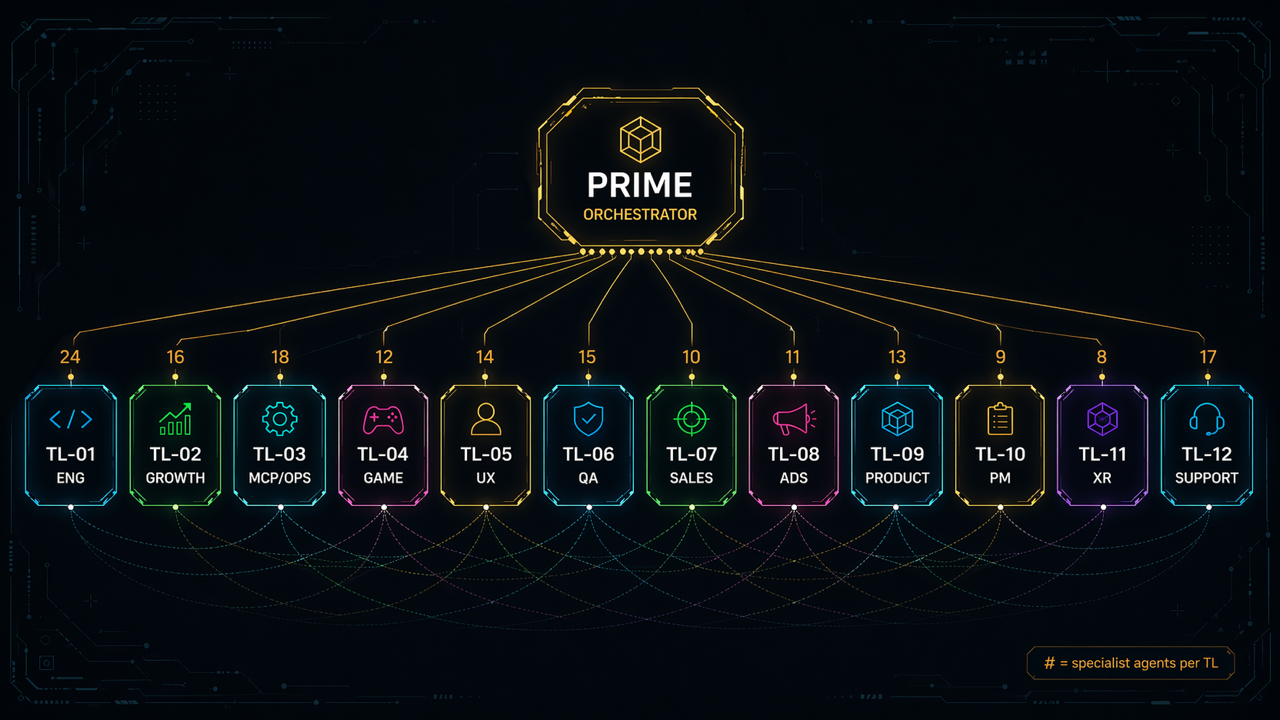
SYSTEM.ROOT / PRIME ORCHESTRATOR — 12 ABot Team Leads · 167 Specialist Agents
Agent fleet preview. Prime routes work through Team Leads to specialist agents after the memory and runtime layers are understood.fleet concept · Apr 24 2026
Start with shared agent memory. Add governed execution when real work touches real systems.
AMS Free gives you 2 custom Automaton-Abots and 100 combined memories. Scale into AMS Professional and AOS when agents need more memory, permission-aware retrieval, approvals, replay, and operational control.